

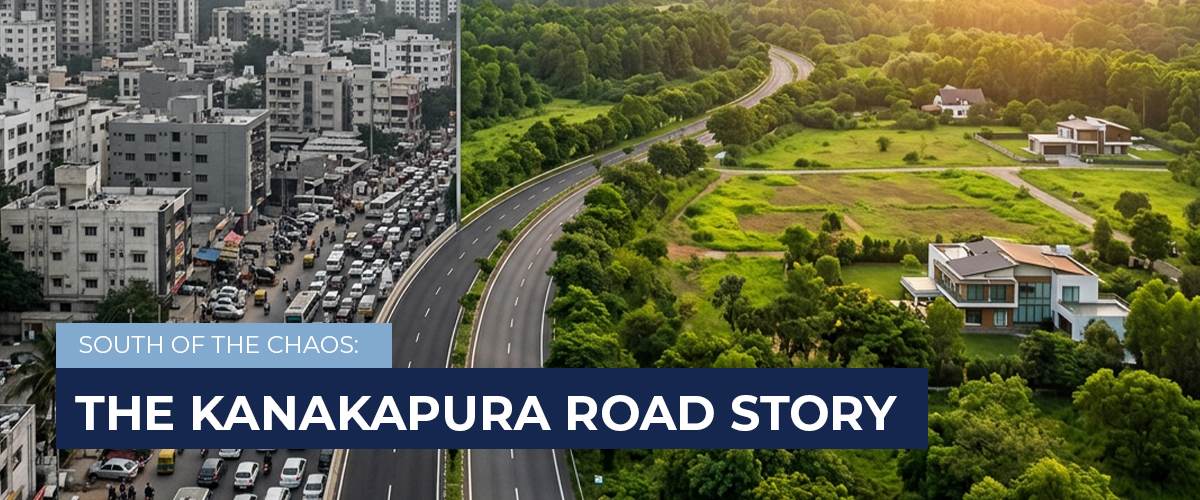
Kanakapura Road didn’t rise because Bangalore chose it. It rose because Bangalore got too loud — and a growing number of people quietly drove south and never came back. This is that story.
“We weren’t looking to leave the city.
We just drove down one Sunday and realised we didn’t want to go back.”
Every city eventually produces its escape route. The road people take when the density gets too much, the commute becomes a tax they stop paying, and the idea of a garden, a quiet morning, and a house with actual breathing room stops being a luxury and starts being a plan. For Bangalore, that road has always gone south.
For most of the city’s growth story, every corridor wore its identity loudly. Koramangala had the startups. Whitefield had the IT campuses. HSR had the cafés. Kanakapura Road had something quieter — the Art of Living campus, Turahalli Forest, a pace of life that felt genuinely different from the rest of the city. That quietness, it turns out, was always the point. The people who recognised it early and put down roots here — drawn by the green cover, the space, the sense that this part of the city had room left in it — are sitting on some of the most steadily compounded real estate decisions in South Bangalore. The corridor didn’t need to announce itself. It just kept growing. And the question worth asking now is what exactly accelerated that growth so sharply in the last five years.
When Work Followed People Home
The story of Kanakapura Road’s rise cannot be told without talking about the laptop. Not as a device — but as the moment it replaced the office commute as the organising logic of a working day. Before 2020, living 25 kilometres from Electronic City was a sacrifice. After 2020, it was a choice — and for a certain kind of Bangalore professional, it became the obvious one. The calculus shifted completely: instead of asking “how close am I to the office?”, buyers started asking “how much house do I get for the same money?”
The answer on Kanakapura Road was significantly more. A plotted development that would have been dismissed as “too far” in 2019 suddenly became a 2,400 sq ft plot with a garden, a clubhouse, and Turahalli Forest as a neighbour — at a price point that Koramangala hadn’t seen in a decade. The WFH generation didn’t discover Kanakapura Road so much as they finally had permission to move there. And when they moved, the developers followed. Which raises the question no one thought to ask in 2018: what does a corridor look like when both buyers and builders arrive at the same time?
“Kanakapura Road is what happens when people stop optimising for proximity and start optimising for life. The laptop made that a practical decision, not just an emotional one.”
The Villa Boom: Buying Space, Not Just a Home
The most telling data point on Kanakapura Road isn’t the price per square foot — it’s what people are buying. Across the corridor, the dominant product isn’t the apartment. It’s the villa, the row house, and the plotted development. Prestige, Brigade, Godrej, Sobha, Puravankara, Total Environment — the developers who typically reserve their villa-format projects for the most premium land in the city have all planted flags here. That’s not coincidence. It’s a signal about who the buyer is and what they’re coming for.
The buyer is not optimising for a floor in a tower. They’re buying land. They want a courtyard. They want the option to build upward. They want the kind of space that Indiranagar stopped offering in 2012 and that JP Nagar priced out of reach by 2019. Kanakapura Road is one of the last South Bangalore corridors where a 30×50 plot in a gated community is still available at a price that doesn’t require selling a previous flat to afford. And the inventory — 500+ plots, 21 villa projects currently active, developers acquiring land for the next wave — tells you the market hasn’t finished arriving yet. So what does the data say about where prices are headed?
| Price per sq ft range flats & villas, 2025 | Property appreciation over 3 years | Appreciation over 5 years |
| ₹7K–14K | 49% | 75% |
What the Numbers Actually Say
Property values on Kanakapura Road have appreciated 15% in the past year alone, 48.9% over three years, and 75% over five. For context, these are not speculative-bubble numbers — they are steady, infrastructure-linked, demand-driven appreciation figures from a corridor that was genuinely underpriced relative to its fundamentals for most of the last decade. The WFH migration accelerated the timeline, but it didn’t manufacture the value. It revealed it. And what makes the current moment particularly interesting is that the corridor still prices below comparable South Bangalore addresses — which means the convergence hasn’t finished.
Mantri Serenity appreciated 26.8% in a single year. Total Environment’s The Magic Faraway Tree commands ₹17,800 per sq ft. Prestige Falcon City sits at ₹19,000 per sq ft. These aren’t outliers at the top of the market — they are the signal that institutional developers have already priced in the corridor’s future. The question for a buyer entering today isn’t whether Kanakapura Road appreciates further. It’s whether the entry point they find now will look obvious in five years — the way 2020 looks obvious now.
Kanakapura Road — Price Appreciation by Timeline
Timeframe Flat Appreciation Context
| 1 Year ▲ | 3 Years ▲ | 5 Years ▲ | 10 Years ▲ |
| 15% WFH demand stabilising; villa launches accelerate | 48.9% Post-pandemic migration surge; metro extension announced | 75.4% NICE Road connectivity; institutional developer arrival | 130% Long-term infrastructure compounding since metro Phase 1 |
The Green Line and What Comes Next
For years, the counter-argument to Kanakapura Road was always the same: beautiful, but the commute. That argument has been steadily dismantled. The Green Line metro already runs along the corridor and reaches Silk Institute. But the more significant development is what comes next — as per metro officials, the Green Line extension on Kanakapura Road is in the pipeline, with the line proposed to go all the way past the NICE junction to Harohalli. If this materialises, it doesn’t just improve commute times — it transforms Harohalli from an industrial suburb into a fully connected node of the city, bringing thousands of daily commuters and workers into the catchment of a corridor that is already appreciating. NICE Road already cuts east-west travel time significantly. The Peripheral Ring Road, once complete, connects South Bangalore to the rest of the city in ways that will make current commute times look dated. And sitting quietly in the background — two of the three shortlisted sites for Bangalore’s planned second international airport are located on or near Kanakapura Road. If that materialises, the appreciation event it would trigger would be the largest single catalyst the corridor has ever seen.
The Green Line’s existing stations have already nudged prices upward in their catchment zones. The pattern is consistent across Bangalore: a metro station within walkable distance adds 8–12% to property values in the surrounding area within 18 months of opening. With the Harohalli extension proposed and the second airport still unpriced, Kanakapura Road has multiple such events still ahead of it. For buyers, this means the best infrastructure arguments for the corridor haven’t been made yet — they’re still being built.
4%
Average rental yield
Kanakapura Road, 2025
500+
Active plots for sale
across the corridor
30–40%
Projected appreciation
if second airport confirmed
“The people who moved to Kanakapura Road before the developers arrived thought they were escaping Bangalore. They were actually getting ahead of it.”
What You’re Actually Buying
The real product on Kanakapura Road isn’t a property configuration or a price per square foot. It’s a specific kind of life that the rest of Bangalore has been paving over for twenty years. Turahalli Forest — one of the last urban forests left in the city — is walkable from gated communities that launched in the last three years. The Art of Living campus, Pyramid Valley, and the Bannerghatta border mean that the green buffer around this corridor isn’t an accident of geography. It’s structural. Developers cannot build over a forest reserve. That scarcity is permanent, which means the liveability premium it creates only compounds over time.
For WFH professionals, the calculus is now straightforward. You can have a 1,200 sq ft apartment in Koramangala, forty minutes from a commute you take twice a week, at ₹1.8 crore. Or you can have a 2,400 sq ft plot in a gated community on Kanakapura Road — with a garden, a forest as a neighbour, a clubhouse, and a twenty-minute drive to Electronic City — for roughly the same money. The people choosing the second option aren’t sacrificing the city. They’re redefining what the city is supposed to give them. And that redefinition is exactly what makes this corridor’s story still early.
The escape route, it turns out, leads somewhere worth arriving.